
Welcome to Week 3 GPP Leverage! Last week, we considered how preseason playing time might help us interpret the opening week and identify potential overreactions or underreactions from the field. We now have another week of evidence, but there is still plenty we don’t know about these teams. This week, I want to shift the focus toward how we put our lineups together. Even when we agree with our opponents about which players are appealing, we may be able to gain leverage by combining those players differently.
Oftentimes I find both myself and others in NFL DFS defaulting to direct leverage off the chalk or simple contrarian pivots. As a hypothetical example, if Ja’Marr Chase is $8,500 and projected for 40% ownership, the natural inclination for leverage seekers might be to either play his RB teammate Chase Brown projecting for 10% ownership, to pivot to an $8,700 Jaxon Smith-Njigba projecting for 15% ownership, or to roster his opposing D/ST. And while all of those options can be completely viable, we also have plenty of leverage strategies available to us simply through roster construction. One roster-construction leverage strategy I’ve been experimenting with more over the past year has been the idea of a secondary stack.
By now, everyone who has played DFS regularly understands the idea of a primary stack, which includes rostering one or more skill players from the same team as the lineup’s QB. We use stacks to correlate our bets on specific passing games or offenses, reducing the number of independent outcomes we need to get right to win tournaments with top-heavy or graduated payout structures. So if a primary stack is a good idea, why shouldn’t a secondary stack also be a good idea? Just because we can only roster a single QB per lineup doesn’t mean we are prohibited from utilizing multiple stacks per lineup.
In recent seasons, I’ve experimented with various forms of secondary stacks. Last week, I liked the outlook for the Jets’ offense as a whole and took some shots on rostering the combination of Breece Hall and Garrett Wilson together even though I didn’t really want to roster Geno Smith. In Week 1, our own Mike Leone won the prestigious DraftKings Thunderdome contest by rostering both Derrick Henry and Zay Flowers without Lamar Jackson. And just last night, we saw Bijan Robinson and Drake London lead the TNF slate in fantasy scoring even though Michael Penix Jr. was not in the optimal lineup, albeit in showdown format. Ultimately, nothing should stop us from considering secondary stacks in our lineups if they allow us to gain leverage via a strategy our opponents aren’t utilizing often enough.
With that in mind, let’s dig into the Week 3 slate, focusing on possible secondary stacks.
To see how these combinations have worked historically, I looked at secondary stacks in Milly Maker and Spy contests over the past several seasons. For this analysis, a secondary stack means two or more RBs, WRs, or TEs from the same team in a game separate from our QB’s game. If we roster Josh Allen with two Chargers in Week 3, for example, those Chargers would be double bring-backs, not a secondary stack. If we roster Allen with two Panthers, that is the kind of combination we’re examining here.
The tables below show how often these constructions appeared throughout the field and among the best-finishing lineups. The Milly sample covers 2022–2025, while the Spy and Double Spy sample covers 2023–2025. Both are limited to Weeks 1–17 and slates with at least eight games.
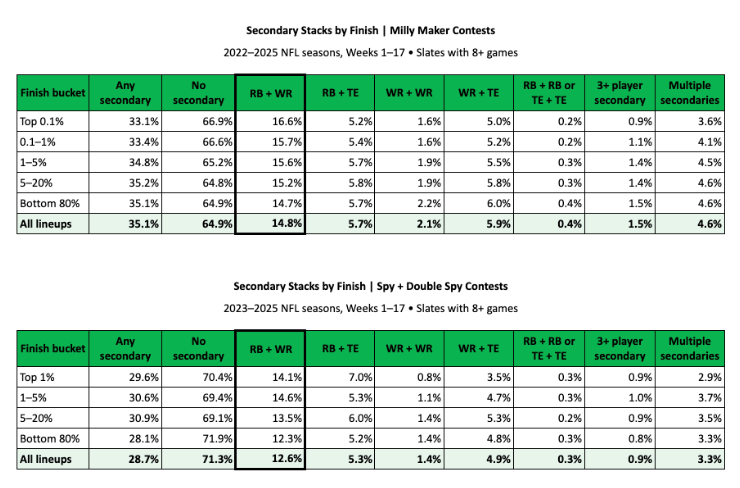
The combination that stands out most consistently is RB + WR. These pairs appeared in 14.8% of all Milly lineups but 16.6% of the Top 0.1%. In the Spy and Double Spy contests, they appeared in 12.6% of all lineups and 14.1% of the Top 1%. Other combinations can certainly work, and RB + TE actually gained more representation at the top of the Spy contests. But RB + WR gives us the clearest agreement across the two contest types, while WR + WR and WR + TE generally became less common as we moved toward the top.
That makes some intuitive sense. An RB and a WR can both benefit from a productive offense without needing their QB to have a massive fantasy game. Two pass catchers hitting their ceilings are more likely to bring the QB along with them, leaving us to wonder whether we should have used that offense as our primary stack instead. That dynamic shouldn’t rule out those combinations, but it gives us a useful question to ask when considering them.
The lower usage in Spy contests makes me think the field has left opportunities on the table when hand-building single-entry lineups. Once we’ve chosen our primary stack, it can feel more comfortable to spread the remaining spots across different teams. We might like both an RB and his teammate at WR but instinctively choose only one because we aren’t playing their QB. I assume this discomfort when hand-building single-entry lineups explains some of the usage gap between the Milly and Spy contests. The tables can’t tell us why people built their lineups that way, but the 12.6% rate across Spy lineups leaves plenty of room to consider a construction that appeared in 16.6% of the very top Milly lineups. Of course, that isn’t a target rate we need to copy across different contests; rather, it’s a reason to question whether we’re dismissing these pairs too quickly.
There are limits to how far we should take this. Secondary stacks as a whole didn’t show a consistent advantage across the two contest types, and the RB + WR results varied by season. The useful takeaway is that we can comfortably pair teammates we already like, and we shouldn’t shy away from it. At the same time, we don’t need to force a secondary stack into every lineup. We also don’t know how often this week’s specific pairs will appear together just from looking at their individual ownerships. Two popular teammates rostered together aren’t automatically a contrarian combination.
Building on this analysis, let’s work through some possibilities on this slate. These examples are meant to generate ideas for this week and beyond, rather than identify specific combinations I’m committed to rostering on Sunday.
Ravens vs Cowboys
We create the highest-quality NFL content
Our team includes renowned fantasy analysts Evan Silva and Adam Levitan, high-stakes professional DFS players, and specialists who cover niche areas that we believe are important to understand.
We don’t sell lineups or claim to have all of the answers. We do analyze what’s happening in a way that’s digestible and actionable, to prepare you to make the best decisions possible during the 2026 NFL season.
To read this content, you’ll need our NFL In-Season package.
Full Details! » Already a subscriber? Log In