

A Game Theory Approach to Winning Your Pool
Editor’s Note: This article was written by PoolGenius, whose tools and simulations have helped subscribers report more than $10 million in winnings across sports pools since 2017.
Bracket Pools Are Game Theory Contests, Not Prediction Contests
Most people approach March Madness brackets as a prediction exercise. They try to pick the teams most likely to win each game and hope their bracket is the most accurate.
But bracket pools are not prediction contests. They are game theory contests.
Your goal is not to maximize bracket accuracy. Your goal is to maximize expected value relative to the other entries in your pool.
That distinction matters because most pools are extremely top-heavy. Whether it is winner-take-all or only a small percentage of entries getting paid, finishing 40th out of 100 earns the same as finishing last.
What actually wins pools are the picks that are both:
- Correct
- Different from the majority of your opponents
If your champion pick is the same as half the pool, that outcome does very little to help you move up the standings. The picks that create separation are the ones where you are right and the field is wrong.
That is where the real edge comes from.
Pool Size Determines How Contrarian You Should Be
The optimal bracket depends heavily on the number of entries in your pool.
In a small office pool with 10 to 20 entries, extreme contrarian picks are rarely necessary. The odds that someone nails a highly improbable bracket are low, so leaning more heavily on strong teams and letting others take unnecessary risks can be profitable.
Large pools behave very differently.
In a 300-entry contest, someone is likely to get several low-probability outcomes correct simply through variance. A bracket that might win a 15-person pool can easily finish far outside the money in a field that large.
The effect becomes even more obvious in massive contests. In ESPN’s 2011 bracket challenge, which featured millions of entries, two people correctly picked the entire Final Four despite it including No. 8 seed Butler and No. 11 seed VCU. In a field that large, someone is far more likely to hit a highly improbable combination simply through variance.
As the pool grows, differentiation becomes more important. The goal shifts from minimizing mistakes to maximizing the probability of finishing first.
This is the same trade-off DFS players face in large-field tournaments.
Scoring Rules Change the Optimal Strategy
Not all bracket pools reward the same outcomes.
In the common 1-2-4-8-16-32 scoring format, the champion pick is worth 32 times the value of a first-round game. The majority of the points are concentrated in the final rounds, so the most important decisions in your bracket involve the teams you project to reach the Final Four and win the tournament.
In flatter systems, such as 1-2-3-4-5-6, early-round results matter far more. A strong first round can create a meaningful lead that is difficult to overcome later.
Upset-bonus formats introduce another layer of strategy. Pools that award points based on seed differential dramatically increase the value of underdogs. In those contests, selecting several double-digit seeds to make deeper runs can be mathematically justified because the few that hit generate disproportionate scoring.
Understanding your scoring system is critical before making any picks.
The Real Edge: Pick Popularity vs. Actual Odds
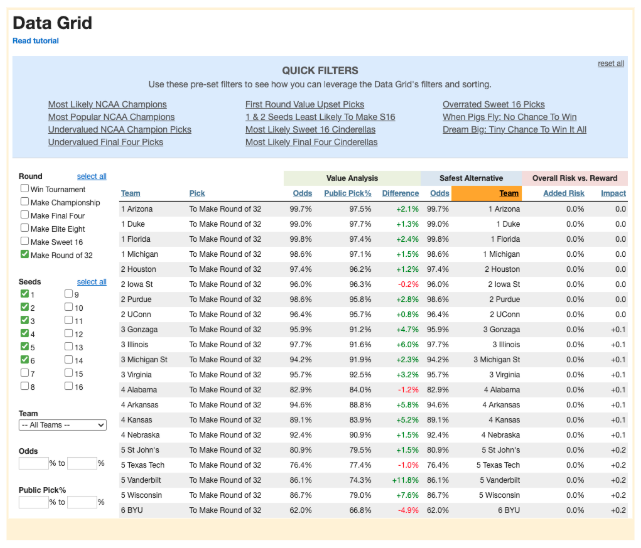
The biggest inefficiency in most bracket pools comes from the gap between public pick popularity and actual odds of advancement.
Public pick rates show how often each team is being selected in brackets across major hosting platforms. Advancement odds estimate the true probability that the team reaches each round based on sportsbook odds, power ratings, and predictive models like KenPom.
Those two numbers are rarely aligned.
When a team is selected significantly more often than its true odds justify, it becomes overvalued. When a strong team is being overlooked by the public, it creates an opportunity for leverage.
Consistently identifying those gaps across every matchup and round is difficult to do manually. PoolGenius analyzes public pick data and advancement odds to automatically surface leverage opportunities.
The PoolGenius Data Grid highlights the largest differences between public picks and true advancement odds, helping you quickly spot high-leverage bracket decisions.
Why Building an Optimal Bracket Is a Math Problem
Understanding the framework is one thing. Translating it into 67 specific picks optimized for your pool size and scoring system is another.
Even experienced players struggle to do this manually.
PoolGenius approaches the problem the same way DFS optimizers approach lineup construction. The system aggregates public pick data, integrates sportsbook odds and power ratings, runs millions of simulations, and produces bracket combinations designed to maximize expected value for your specific pool.
You can use the optimized bracket directly, or use it as a starting point for your own decisions. Either way, the underlying math has already been done.
Survivor Pools: A Different Strategic Problem
NCAA Tournament survivor pools look simple on the surface.
Each round or each day, depending on the format, you select one team to win its game. If that team loses, your entry is eliminated. Once you use a team, you cannot select it again.
But the strategy becomes more complicated very quickly because every pick carries two costs:
- The immediate risk that the team loses the game
- The future value you lose by removing that team from your available options
Most players focus almost entirely on the first factor. They choose the biggest favorite on the board and move on.
The second factor is where much of the edge actually lives.
Unlike bracket pools, survivor contests force you to manage resources across the entire tournament. Using the wrong team early can leave you with no viable options when the tournament reaches the later rounds.
Dead Money Is Everywhere in Survivor Pools
Survivor pools often contain a surprising amount of avoidable mistakes.
In one public pool we analyzed from last year, with 556 entries and a $10,000 prize pool:
- 11% of entries were eliminated simply for failing to submit a pick on time
- 7% were eliminated in the first two rounds after selecting underdogs or near coin-flip games
Nearly 18% of the field was gone early due to preventable errors.
That kind of dead money creates a meaningful baseline edge for anyone approaching the pool strategically. You do not need to be perfect to beat a field that is making basic mistakes.
The real opportunity lies in positioning your entry so that when the field collapses later in the tournament, you still have viable teams available.
Future Value Is the Core Survivor Concept
The instinct in survivor pools is to take the safest team available each round and move on.
But the safest pick is not always the optimal one.
Teams with strong paths to the Final Four or the championship carry enormous future value. Using them early removes some of your best options for later rounds, when the number of viable picks becomes much smaller.
Optimal survivor strategy often targets teams that:
- Are strong favorites in the current round
- Have a limited probability of advancing deep into the tournament
That combination provides high survival probability now while preserving stronger teams for later rounds.
The difference becomes significant by the Sweet 16 and Elite Eight, when the pool may have very few remaining teams capable of winning their games with high confidence.
Path Conflicts Are One of the Biggest Hidden Traps
Because the NCAA Tournament bracket is fixed, planning several rounds ahead is extremely valuable.
Teams do not just advance through the bracket. They also shift between game days as the tournament progresses.
This creates path conflicts where multiple teams you were planning to use end up playing on the same day. If you planned only one round ahead, you may suddenly find yourself without a valid pick.
These scheduling conflicts become especially common in formats that require multiple picks across the Sweet 16 or Elite Eight.
Players who map their path through the bracket early avoid these traps.
Survivor Pools Often End With Field Collapse
Late in the tournament, survivor pools frequently reach a point where most of the field has burned the same handful of elite teams.
If one of those teams loses, the pool can collapse extremely quickly.
In the public pool referenced earlier, 49 entries survived to the championship game, but none had Florida available to pick. Most of the field had been saving Duke for that round, but Duke lost in the Final Four.
Only eight entries were able to make a pick in the championship game, and the remaining field ended up splitting the prize pool.
A single entry that had preserved Florida for the championship would have won the entire $10,000 prize.
Planning your path through the bracket dramatically changes your chances of being the entry still standing when those collapses occur.
Multiple Entries Create Strategic Flexibility
Large survivor pools are inherently high-variance contests.
Running multiple entries allows players to explore different paths through the bracket. One entry might follow the most likely advancement path, while another preserves stronger teams for later rounds or diverges in a different region.
This approach creates diversification. If a popular path collapses, entries positioned differently can gain substantial leverage.
The challenge is managing those paths across multiple entries while tracking which teams have already been used.
The PoolGenius Survivor Tool
The PoolGenius NCAA Survivor Tool is designed to make those decisions easier.
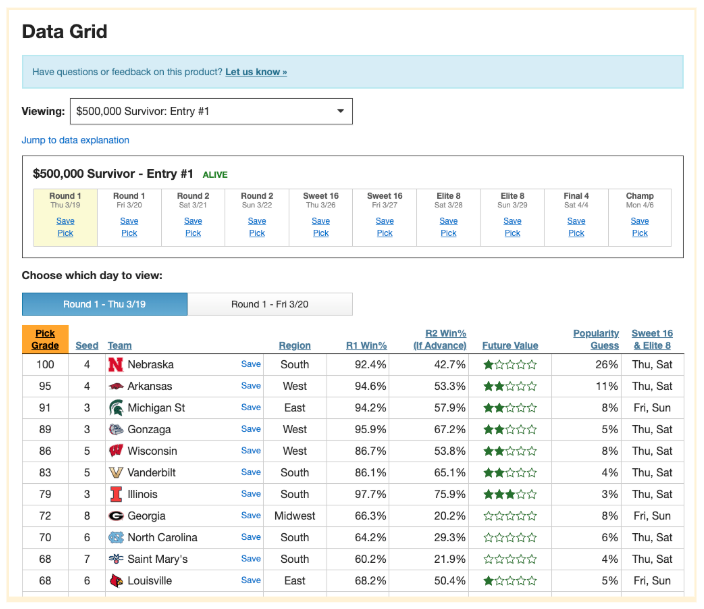
It combines advancement odds with projected pick popularity to grade each possible selection. You can track every entry you have in the pool, see which teams remain available, and visualize your path options across future rounds.
Instead of trying to piece together probabilities, matchups, and pick popularity manually, everything appears in one interface.
In a format where a large portion of the field is making decisions on instinct, having the full picture creates a meaningful edge.