
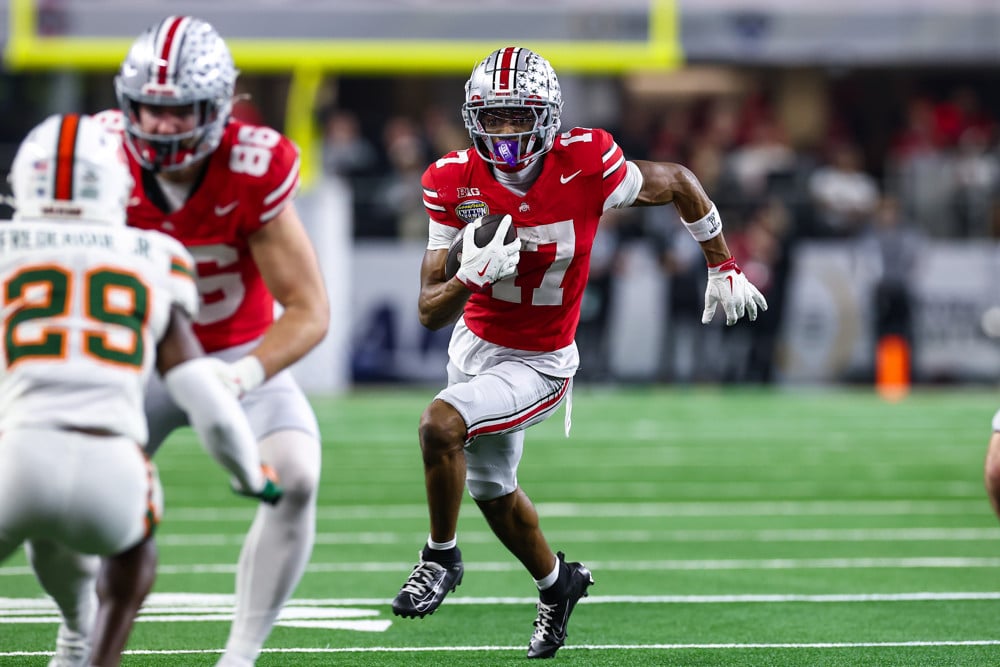
Last year, Tetairoa McMillan was picked within the first four rounds of many fantasy leagues. Travis Hunter, Emeka Egbuka, and Matthew Golden weren’t far behind. Rewind back to 2017, and Corey Davis was the fourth overall pick in the real NFL draft… and had a best ball ADP of 129.8. It certainly feels like things have changed.
In this article, we will set out to determine whether rookies — and specifically rookie wide receivers — have gone the way of Netflix subscriptions and college tuition, and spiked in price over the past decade, or if this phenomenon is all in our heads. Moreover, we’ll look at whether rookie WR production has spiked correspondingly, or if the hypothesized cost increase has come without equivalent growth in output.
HAVE ROOKIES GOTTEN MORE EXPENSIVE?
For this exercise, we’ll be using FFPC data because it goes back further than Underdog. 2017-24 data is via RotoViz, and 2025 FFPC ADP data comes from FantasyMojo.
* Between 2017-20, zero rookie WRs had a top-100 overall ADP. That includes three top-10 NFL Draft picks in Davis, Mike Williams, and John Ross, along with players like Jerry Jeudy and CeeDee Lamb, who were universally regarded as high-end prospects. Justin Jefferson had 1,400 receiving yards from a 167.9 FFPC ADP, and Lamb was productive as a rookie as well, potentially chasing Ja’Marr Chase‘s ADP up to 62.3 in 2021. Chase, of course, also smashed as a rookie, and while No. 8 overall pick Drake London only had a 96.6 ADP in 2022, that was still a clear increase in cost relative to where London’s predecessors were drafted.
* In 2023 and 2024, rookie wideouts like Puka Nacua, Malik Nabers, Ladd McConkey, and Rashee Rice smashed, and the result was higher rookie WR ADP than we’d ever seen before in 2025. From 2017-24, there were 34 WRs picked in the first round of the NFL Draft. Nine of them went in the top 100 picks of FFPC drafts. All four 2025 first-round WRs went in the top 100 (Golden was the lowest with an ADP of 84), despite Golden being largely agreed upon as a below-average analytical prospect and Travis Hunter having questions about his WR versus CB playing time. There were also as many Day 3 WRs (Rounds 4-7 in the NFL Draft) picked in the top 200 in 2025 as there were in the previous four seasons combined.
This effect becomes clear when you stratify by NFL draft capital. Over the past decade, WRs drafted between picks 1-16, picks 17-32, and picks 33-64 have all become significantly pricier on average. Over the past two years, five of eight WRs picked in Round 2 of the NFL Draft have had an ADP in the first 10 rounds of FFPC leagues. Over the three years prior, it was only four of 14 — and that was still post-Jefferson era when rookie WRs had climbed some compared to 10 years ago. Simply put, rookie WRs are far more expensive than they’ve ever been.
WHAT ABOUT RUNNING BACKS?
In 2025, Ashton Jeanty was the 11th pick on average in FFPC leagues. This isn’t really that remarkable; he was the fourth overall pick, and other RBs like Bijan Robinson in 2023 (8.2 ADP) and Saquon Barkley in 2018 (7.6) were first-round picks after being top-10 NFL Draft selections. Omarion Hampton was the No. 22 overall pick and had a comparable ADP to Najee Harris in 2020 (20.9) and Clyde Edwards-Helaire in 2021 (26.7), both of whom were also picked in the latter half of the first round.
2025 RB ADP was significantly different than in previous years after the first two, though. TreVeyon Henderson was the earliest-drafted second-round running back of the last five years, and RJ Harvey was third (of nine). Perhaps more notably, 10 RBs had an ADP inside the top 120 overall picks, while no other year had more than six. 2025 was heralded as an exceptionally strong running back class, and it seems likely that RBs were actually pushed down in the real NFL Draft because teams knew they could get capable talents later, even if they missed on the top guys. Nonetheless, it’s still worth mentioning that there were eight Day 3 RBs with a top-200 ADP last year, compared to 14 combined over the previous four seasons. Six of the eight earliest ADPs from Day 3 RBs over the past half-decade came in 2025 (Dameon Pierce and Michael Carter were the exceptions).
It seems possible we are seeing inflated RB ADP for back-end rookie RBs, but the evidence of extreme inflation among the earliest-drafted RBs is less clear. Henderson was the 38th pick, for example, and had basically the same ADP (38) as Breece Hall (39), the 36th pick in 2022. Zach Charbonnet in 2023 and Jonathon Brooks in 2024 both had less-than-ideal situations entering the league, but their ADPs were both pretty low given their draft capital. The late-round guys might be getting propped up now, but because the earlier guys aren’t seeing the same skyrocketing price tags as their WR counterparts, we’ll focus primarily on the wide receivers today.
ARE ROOKIE WIDE RECEIVERS SCORING MORE?
We’ll start with a zoomed-out view of whether rookie WRs are scoring more in general. The answer to that is unsurprisingly affirmative.
Of course, this lacks the important context of where these rookies were actually being picked in fantasy drafts. Rookie wideouts are scoring more, but we already know they are much pricier than they used to be. So are they actually good picks?
This is a difficult question to answer, especially since there aren’t that many fantasy-relevant rookie WRs drafted each year, and the sample of rookie WRs at the newly inflated ADPs isn’t very big. Plus, there are game-theory aspects that make rookies more desirable than their end-of-season numbers would suggest:
- Rookies get better as the season progresses
- Rookies are theoretically more unknown than veterans entering the season, giving them a wider range of outcomes versus a veteran with the same mean projection
I gathered all rookie WRs from 2021-25 and identified every veteran WR picked within eight picks of each of them in either direction (so a 16-pick range for every rookie WR). Some players had one ADP neighbor. Some had 10. Then, I compared each rookie’s Weeks 1-18 PPR points per game and Weeks 11-18 fantasy points per game (to account for rookies progressing throughout the year) with their corresponding vets. The takeaways:
- Over the last two years, rookie WRs have underperformed ADP. Just 30.6% of rookie WRs outperformed their veteran counterparts over the full season, with just 33.3% outperforming during Weeks 11-18. For 2025 alone, these numbers were 33.3% and 38.9%, respectively.
- For 2021-25 overall, WRs drafted in the first two rounds of the NFL Draft have been a fine investment. 66.7% of first-round WRs have outperformed their veterans for the full season (only 50% in Weeks 11-18, interestingly). 45% of second-round WRs have outperformed their veterans for the full year, and 52.6% in Weeks 11-18. This isn’t a perfect exercise because we know rookie ADP has spiked hard in recent years, but samples are so small when you trim things down further. But for those curious, six of 10 first-round WRs outperformed their veterans in 2024-25 (four of 10 in Weeks 11-18). For Round 2 picks, that hit rate is two of eight for both the full season and Weeks 11-18.
- We’re basically doing the same analysis twice by looking at just top-100 ADP rookie WRs (sorting by fantasy ADP rather than NFL Draft capital), but it should be mentioned that the same idea holds true for highly drafted rookies in fantasy. 53.8% of top-100 rookie WRs have outperformed their veterans in fantasy PPG (46.2% for Weeks 11-18 specifically).
- WRs picked in Round 3 of the NFL Draft have underperformed relative to vet WRs drafted nearby. Just five of 20 third-round wideouts outperformed their ADP neighbors for the full season, with that number rising to eight of 20 when you look only at Weeks 11-18.
- Things get even worse when you look at Day 3 WRs. Among the 16 Day 3 WRs drafted on a regular basis between 2021-25, only 18.8% of the sample outperformed the vets for both the full season and Weeks 11-18. The caveat: Puka Nacua falls into this group, and there’s a good argument that whiffing on a high percentage of these guys is okay as long as you hit on a Puka every once in a while. However, it’s also fair to question whether Puka is a once-in-a-generation outlier or whether there will be future late-round WRs to emerge from the ashes to finish as an elite WR1. Regardless, we know for a fact that the overwhelming majority of late-round NFL WRs have not panned out for fantasy.
DO ROOKIE WIDE RECEIVERS HAVE HIGHER CEILINGS?
Next, we want to try to determine whether rookies have higher ceilings than the veterans drafted around them. Frankly, this is even harder than normal scoring to discern in a limited sample, and logic needs to play a role here as well until we have more seasons of data. But in an effort to quantify ceiling, we used the following methodology:
- Since many low-scoring weeks don’t matter (i.e., there’s minimal practical difference between scoring three points in a week vs. scoring seven), we calculated the average weekly WR36 score from 2021-25 to be 10.8 PPR points. From there, we took the excess scoring in each week for each player to estimate how many points a player would actually contribute to an average best ball roster. We’ll refer to this as “Usable Points.”
- Next, we repeated the same analysis we did above, just with a player’s Usable Points (points minus 10.8) instead of points per game. In addition to looking at averages across different buckets like we did above, we also looked at the 90th-percentile outcomes for different groups.
In short, not much changed when looking at mean Usable Points per game instead of regular PPG. Only 25% of rookie WRs over the past two years outperformed their veteran neighbors in Usable PPG in 2024-25, and that number dropped to 22.2% when looking only at Weeks 11-18. 54.2% of first-round draft picks between 2021-25 outscored their vets (45.8% in Weeks 11-18), and 50% of second-round picks outperformed for both the full season and Weeks 11-18. Day 3 rookies were again brutal in terms of hit rate, with just 18.8% outperforming in Usable PPG for the whole year and only one (Puka) in Weeks 11-18.
Finally, we want to look at the high-end outcomes. Fantasy football is a game of identifying right-tail outliers, both on a seasonal and weekly basis. For this, we stratified by NFL Draft round and looked at 90th-percentile seasonal outcomes using normal PPG (not Usable Points Per Game) and then 90th-percentile weekly outcomes using single-week Usable Points. Basically, the first four columns of the table below refer to full-season 90th-percentile outcomes, while the final four columns refer to 90th-percentile single-week outcomes. For this, we are again comparing rookie WRs with their ADP neighbors with the same +/- 8 range in ADP, but this time for single-game Usable Points, we are lumping all of the rookie weeks and all of their veteran ADP neighbors into one giant bucket, and then looking at the 90th-percentile outcome of a ton of individual weeks.
| NFL Draft Round | Rookie Weeks 1-18 90th-Percentile PPG | Veteran Weeks 1-18 90th-Percentile PPG | Rookie Weeks 11-18 90th-Percentile PPG | Veteran Weeks 11-18 90th-Percentile PPG | Rookie 90th-Percentile Single-Game Usable Points Weeks 1-18 | Veteran 90th-Percentile Single-Game Usable Points Weeks 1-18 | Rookie 90th-Percentile Single-Game Usable Points Weeks 11-18 | Veteran 90th-Percentile Single-Game Usable Points Weeks 11-18 |
|---|---|---|---|---|---|---|---|---|
| 1 | 13.9 | 14.2 | 15.5 | 15.8 | 11.8 | 10.0 | 10.4 | 9.9 |
| 2 | 12.6 | 11.1 | 15.2 | 13.1 | 3.7 | 5.0 | 5.4 | 5.6 |
| 3 | 8.2 | 9.5 | 8.7 | 10.5 | 0.9 | 2.4 | 2.4 | 3.9 |
There’s minimal difference in full-season outcomes for first-round WRs. Second-round WRs do have noticeably better 90th-percentile outcomes than their veteran counterparts, but the trend reverses for third-round rookies, making it unclear how much to trust that trend for Round 2 guys.
First-round rookie WRs do have slightly better single-week 90th-percentile outcomes than their veteran ADP neighbors, but the trend reverses for guys drafted in Rounds 2 and 3, again making it hard to definitively say that rookies have higher weekly ceilings. Again, this is a limited sample — there have been 24 total first-round WRs over the past five years — and we can still use our brains to think through this stuff rather than wholly relying on a 24-player sample. However, it’s worth noting that the numbers don’t bear out some drastic difference in ceiling between rookies and veterans at either the seasonal or weekly level.
BEST BALL VS. SEASON-LONG THOUGHT PROCESS
As a reminder, this is best ball-centered analysis. The calculus could change slightly in season-long numbers, although we’re largely using numbers (points per game and Usable Points per game) that apply to season-long as well. ADP would be slightly different with rookies often getting pushed up in best ball formats on account of a sharper drafting community and more hypothesized weekly and seasonal upside.
Furthermore, in season-long, you aren’t punished as much for swinging on rookies, particularly in the late rounds. While late-round WRs graded out terribly in this analysis, the Puka Nacua season still exists, and the cost of whiffing on a late-round rookie is much lower when you can simply cut ties if they fall short of expectations. In best ball, where you are committed to rostering a player all season, the cost of missing on a high-risk rookie is increased. You can mitigate this somewhat by blending archetypes across your teams, drafting veterans who project for strong early-season roles to make up for decreased rookie scoring early in the year, and then ideally your rookies take over your starting spots by the end of the season.
CONCLUSIONS
Let’s summarize our conclusions:
- Rookie WR ADP has spiked significantly over the past decade, and particularly within the past few years. This trend holds true basically however you slice the data: first-round picks, Day 2 picks, and late-round rookies are all going earlier than ever.
- There hasn’t been the same clear multi-year trend at the RB position, although Day 3 rookie RBs went far earlier than ever before in 2025. The 2025 RB class was also widely viewed as an exceptional class, so it’ll be worth monitoring whether late-round rookie runners also go early in 2026.
- Rookie WR scoring looks to have increased within the past decade as well. With that being said, rookie WRs have underperformed ADP over the last two years at their newly inflated ADPs. However, it’s a pretty small sample, and it’s mostly driven by later-round rookies. Day 3 rookie WRs have an awful hit rate versus ADP in recent seasons, but one of those hits was Puka Nacua emerging from the ashes to finish as a high-end WR1.
- The data does not bear out a significantly higher seasonal or weekly ceiling across all rookie WR groups relative to veterans with similar ADPs. With that being said, it’s a pretty small sample, and first-round rookie WRs have boasted higher weekly ceilings than their vet counterparts (but the trend reverses for Rounds 2 and 3 WRs, so it’s hard to definitively say rookies have a higher or lower weekly ceiling). Given the small sample, it’s important to use logic here as well rather than relying solely on the data.
Overall: Yes, rookie WRs are significantly more expensive now. Yes, rookie WRs have underperformed their ADP the last two seasons (in a small sample). No, the ceiling outcomes between rookies and their veteran comparables (based on ADP) have not been different. Rookie WRs still can be great bets, but they are no longer the blind smash they were before the cost changed.