Gambling Problem? Call 1-800-GAMBLER or 877-8-HOPENY/text HOPENY (467369) (NY). Help is available for problem gambling. Call (888) 789-7777 or visit [ccpg.org](http://ccpg.org) (CT).
18+ in most eligible states, but age varies by jurisdiction. Eligibility restrictions apply. Void where prohibited. 1 per customer. Must enter a lineup into the NFL Best Ball $20M Headliner Contest. $25 entry fee. Bonus issued as 1 ticket to NFL Best Ball $20M Headliner Contest. Ticket reward is site credit valid for use only on NFL Best Ball $20M Headliner Contest. Ticket reward is single-use and expires at contest lock on 9/9/26. See terms at https://www.draftkings.com/promotions. Ends 9/9/26 at contest lock. Sponsored by DraftKings.
“If you can’t spot the sucker in the first half hour at the table, then you are the sucker.” In poker or best ball, there’s accuracy to this Rounders quote. That’s not to say there can’t be sharp drafters who break the rule, but more importantly, it should be a part of our process as we are reviewing our drafts. Through studying how others are drafting, we can not only learn strategies to employ but also identify mistakes to avoid.
And that is the inspiration behind this article. We are still very early in drafting season, and while there is substantial content around what to do, it would be helpful to also touch on perhaps what not to do. Throughout my early drafting, I am paying particular attention to how others are drafting and trying to identify common trends. What teams are people reaching to stack? How are teams adapting their strategy when they miss said stack? Which roster constructions are most popular? And my favorite: What are the common mistakes I am seeing?
1. Strong opinions, too strongly held
Too often, I see people go into a draft locked into a certain strategy, roster construction, or desired stack. There is nothing wrong with having plans going into a draft, starting with those strong opinions, but they need to be weakly held. We should be drafting with a flexible mindset and be willing to quickly pivot and adapt as necessary. In 2026, my strong lean for the majority of my drafts will be one or two RBs in the first three rounds and then waiting until the mid- to late rounds to grab another. But after I start a draft with Ja’Marr Chase and Drake London, and Brock Bowers falls to me in the third round, I know I quickly need to change my strategy. I shouldn’t be avoiding the falling value and a unique combination to start the draft simply because I’m expecting the majority of my drafts to have that early RB. When taking a portfolio approach to best ball and accepting you’ll have a large number of entries, you will likely feel less pressure to hit on your pre-draft strategies every time.
2. Reaching on stacks
Stacking is a key to success in these large-field best ball tournaments, but it shouldn’t be our primary goal. Rather, it is a tool or strategy we often leverage to achieve our goals of advancing each round and increasing our odds of winning the final week.
I say this because we need to keep that perspective when we are trying to stack. And all too often, I see people prioritizing their stacks above all else — specifically, reaching for their stack QBs or pass-catching counterparts at the expense of player value. There are a couple of reasons not to do this.
First, you can look at Michael Leone’s analysis that shows sacrificing a lot of value to complete your stack is as bad, if not worse, than not stacking at all.
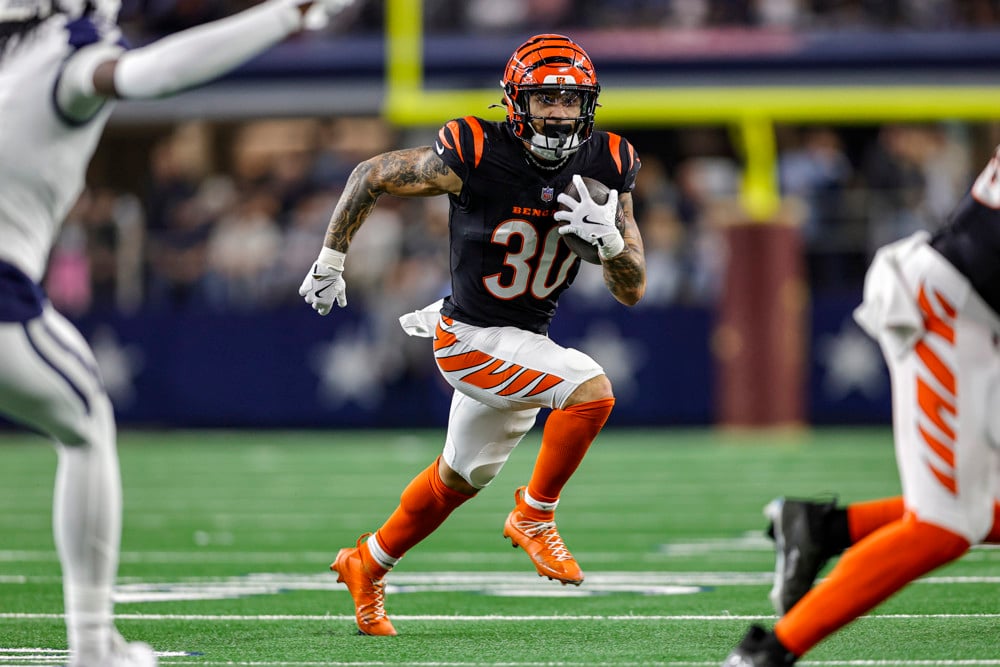
Second, I often see people reaching for a QB when they already drafted two of that player’s pass catchers. In reality, having those pass catchers should actually increase your willingness to wait on the QB because it is less likely another drafter is going for that stack. A great example for 2026 is going after the early-round Bengals stack. We have four Bengals in consideration: Ja’Marr Chase (ADP 4), Chase Brown (ADP 23), Tee Higgins (ADP 34), and Joe Burrow (ADP 51). It is important to be aware of where your competition for a QB is and who they’re drafting. Consider that you take Chase in the first and Higgins in the third, and the guy at the No. 1 spot takes Brown and Josh Allen at the turn.
When it comes back around to you in the fourth, you do not need to reach on Burrow, as he’s unlikely to be taken by your only competition. And if we see his ADP drop throughout the summer, similar to last year, you may even be able to wait until the sixth round for Burrow to make it back. With Burrow’s opening ADP of 51, I’d likely draft him in the fifth, given this situation. But I’ll be watching all summer to see if his ADP drops and that double stack can be held at the cheap sixth-round price point eventually. This mindset is another reason I recommend the portfolio approach, where you can take chances on your stack partners falling in exchange for getting better talent in those rounds that you’d otherwise be reaching on, while also accounting for ADPs shifting throughout the summer.
3. Running backs not complementing each other
People have gotten smarter about drafting RBs later in the draft, mostly prioritizing those with significant upside, even if they are likely to score substantially fewer points than other RBs available. And I think this is definitely the correct way in general to be thinking about the mid- and late-round RBs. However, I do not believe people are thinking about how their RBs complement each other within a roster.
The two strategies this is most evident in are hyperfragile and zero-RB builds. For hyperfragile builds with two or three RBs drafted early, people should be looking for a fourth RB who can provide a solid weekly floor. For that team to be successful, you are counting on your top two or three RBs having great seasons, so rather than drafting a fourth RB hoping for a breakout (e.g., Braelon Allen), I prioritize RBs who I know will be playing and can provide me with essential points during bye weeks or perhaps a missed game or two (e.g., Dylan Sampson).
For zero-RB builds, people should be taking the opposite approach. Given you will have a large number of RBs and no top-of-the-draft anchors, you should be looking for upside with just about every RB pick. This strategy is particularly important for modified zero-RB teams, where you’re really just looking to hit big on one high-upside RB.
4. Poor use of draft capital
I mentioned earlier that we should be flexible in our drafts, but there are some hard-and-fast rules we should not break. One of those is around draft capital at the QB and TE position (particularly for Underdog-style drafts with 18 roster spots). If you draft an elite QB or TE, you should not be drafting three of that position. The high cost for those positions includes the expectation that you will be gaining an extra roster spot for another position. When drafting a third, not only are you selecting a player who is unlikely to be relevant on a league-winning team (remember — we are drafting with the expectation that our early picks will be successful), but you are taking away extra depth from a position of need.
All too often, I am still seeing people grab two late TEs to pair with a Brock Bowers or Trey McBride type, using the arguments that they can be used in the flex, or it is to protect against a position that has a high likelihood of injuries. Or after grabbing an elite QB, drafting a third middle-round QB because it completes a stack. However, this depth most likely only comes into play on teams where the elite QB or TE struggles, and in those situations, we are unlikely to be winning our league or advancing anyway.
5. Playing it safe
This may be the most likely flaw for people new to best ball. It can manifest in a variety of ways, but in general, people are drafting in fear of what might happen rather than with hopes of what could happen. Here are a few clear signs of someone playing it too safe:
- Drafting that third QB or TE after selecting an elite guy at that position
- Drafting a running back’s handcuff
- Prioritizing average projected points over potential upside
- Drafting well-balanced roster builds (i.e., 2-6-7-3)
- Avoiding players with ambiguous roles rather than betting on talent and hoping the playing time works out.
- Drafting veterans with a secure role but capped upside.
These are a few examples, but I am confident you all will recognize other ways in which drafters are handicapping themselves by trying to play it too safe.
If you have found yourself making any of these mistakes, there is still an entire summer to draft and correct these behaviors. And as you keep drafting, the more you start to identify other drafters making these or other mistakes, the better you are likely getting.
Best of luck out there in the drafts, and feel free to keep reaching out to me on Twitter (@JustinHerzig) with any questions, comments, or just to brag about a great draft you had.