
Each year, it’s important to reassess and recalibrate based on changes in the NFL during and since the last season. Usually, there are many micro changes, with players rising and falling in value, new coaching staffs in place, and the occasional rule change. However, the 2025 season felt the culmination of a new meta in the NFL, with defensive schematic and personnel changes forcing offenses into more deliberate styles. This led to radically different best ball ADP on Underdog, specifically at quarterback and wide receiver, which probably reduces the predictive ability of some of our previous best ball guidelines. Much like the modern NFL, it’s out with many of the old rules, and time to put on our critical thinking hats once more.
Key Takeaways
How the market has shifted
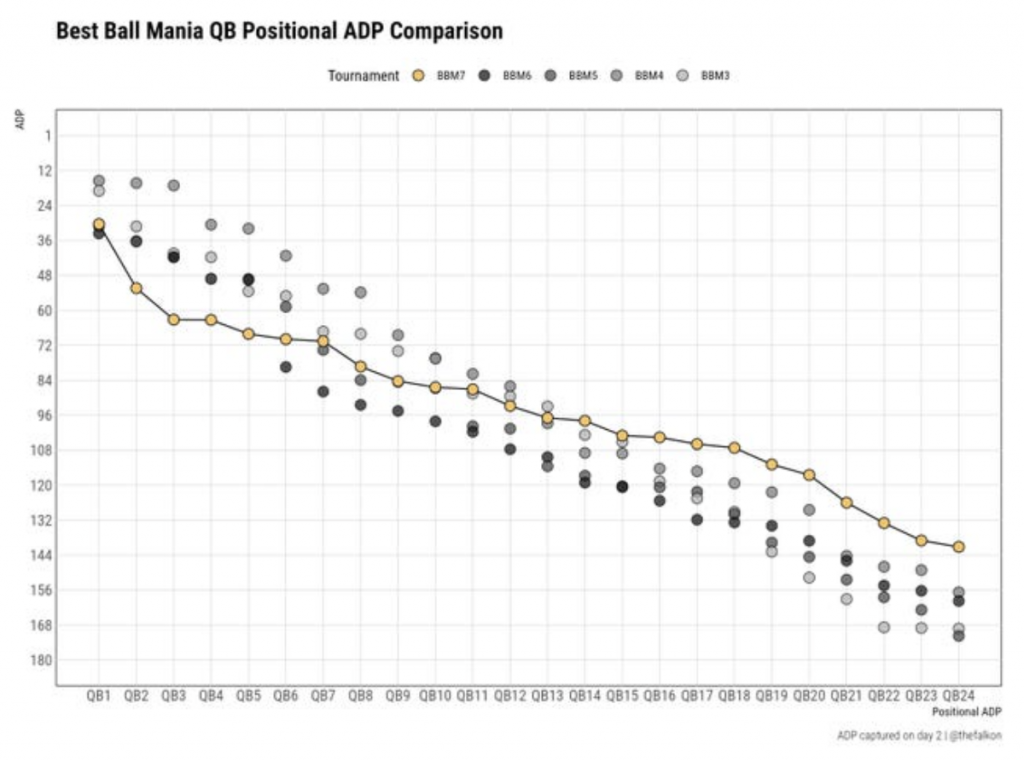
- QBs 1-8 drafted later; QBs 14-24 drafted earlier
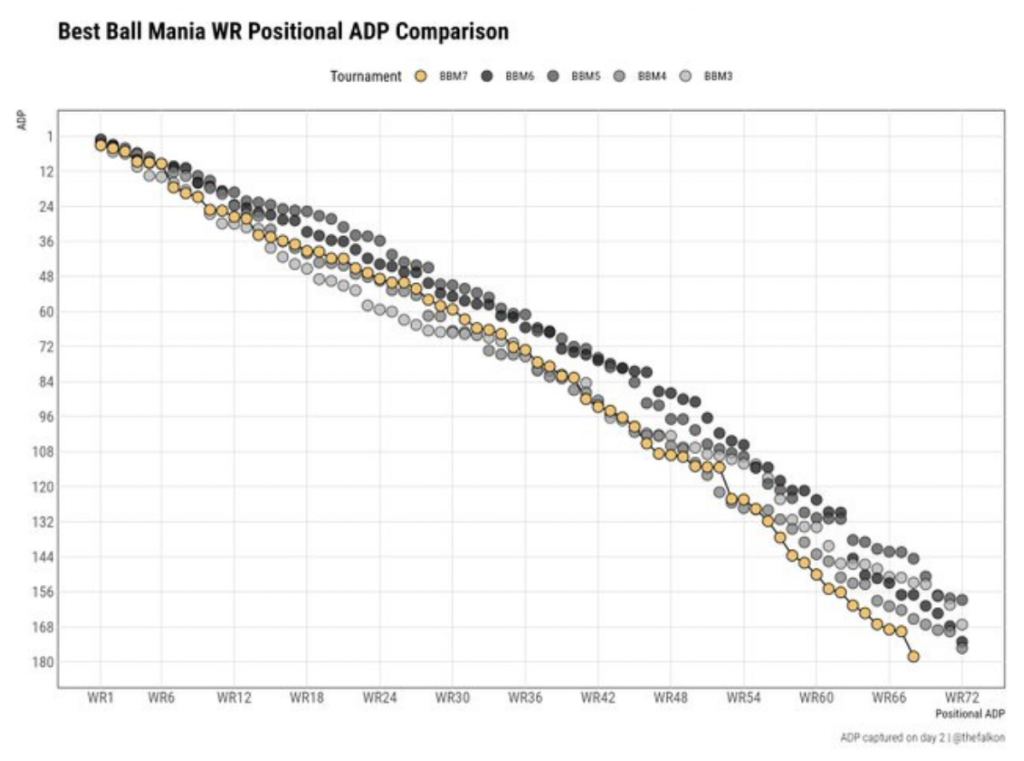
- All WRs drafted later
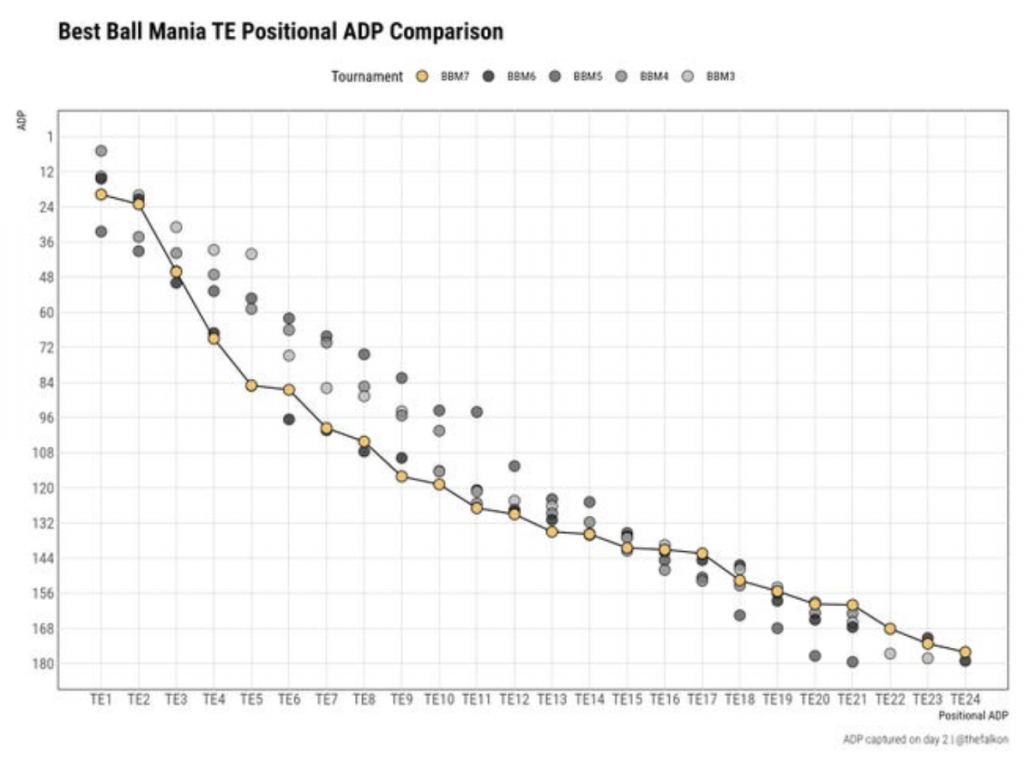
- TEs 4-14 drafted later; TEs 15-24 drafted earlier
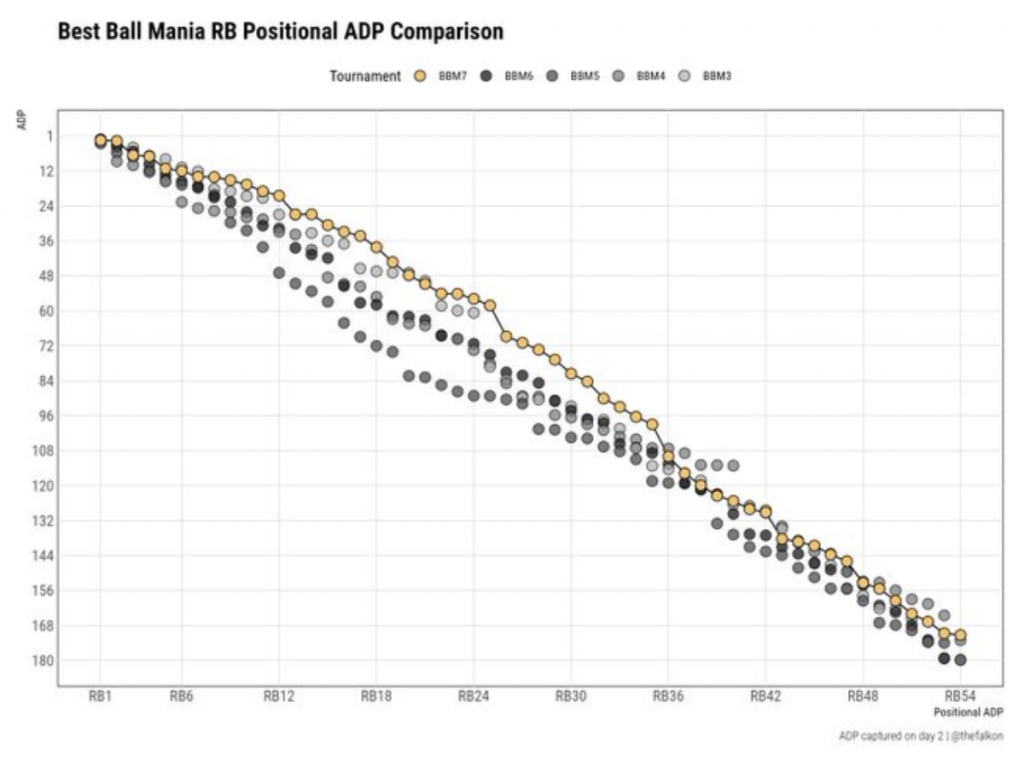
- RBs 1-36 drafted earlier
Why the market has shifted
- Elite QBs offered less of a relative edge due to league-wide reduction in passing volume and efficiency; best ball strategy consensus has shifted to 3-QB builds
- WRs are scoring less due to league-wide reduction in passing volume and efficiency; team WR2/3s hurt most; increased injury rates to top WRs recently
- TE depth has increased due to more playing time; mid-tier tight ends have been a bad bet for the last decade; best ball consensus is an elite-or-wait strategy
- RBs have benefited relatively from the reduced passing volume and efficiency; top RBs have been less injured relatively than WRs over the last few seasons
How I’m playing it in May and June
- Early rounds (1-4): Draft multiple RBs, at least one top WR, and one elite tight end if I can; largely avoiding QB in the first four rounds
- Early/mid rounds (5-10): Draft two QBs, fill out RBs, draft at least one mid-TE if I don’t have an elite, don’t reach at WR
- Mid/late rounds (11-14): Finalize QB and RB
- Late rounds (15-18): Fill out WR, avoid speculative shots with high zero risk (particularly at RB and QB), target tight ends with locked-in roles
How the market has shifted
Put simply, in the first 10 rounds, the market is drafting receivers, quarterbacks, and tight ends much later, while elevating the cost of running backs. After Round 10, the dynamic largely reverses, with QBs and TEs increasing in cost while RBs remain at levels seen in years past (though WRs are still cheaper). See the graphics below from Dan Falkenheim:
Why has the market shifted?
Quarterback
At quarterback, the story is straightforward. With passing volume and efficiency falling, total QB points are dropping.
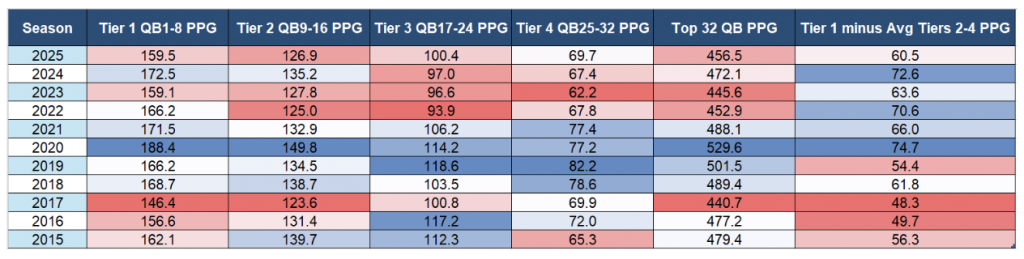
Additionally, the specific drop in Tier 1 QB ADP is probably due to the reduced relative advantage they offered last year (and, to a lesser extent, in 2023).
In 2025, Tier 1 QBs only averaged 60.5 points more than Tiers 2-4 QBs, the lowest figure since 2019. Some of this was probably due to injuries to Tier 1 QBs, including Jayden Daniels and Lamar Jackson. However, Josh Allen and Jalen Hurts also finished with their worst scoring seasons since 2019, suggesting that, even when healthy, elite QBs may be providing less of an edge than in the passing heyday of the NFL.
Additionally, best ball strategy is probably reinforcing this, as consensus has moved to 3-QB builds as optimal, following research like the Best Ball Manifesto, and the use of sims, like The Solver.
Wide Receiver
Receivers are falling in ADP for a few reasons as well.
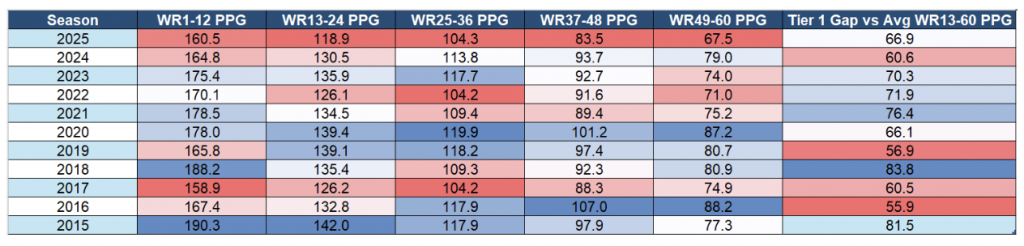
The foremost reason is that, like with QBs, they are simply scoring fewer points amidst the falling passing volume and efficiency of the NFL’s new meta. As we can see below, WR scoring was near decade-low levels across all tiers.
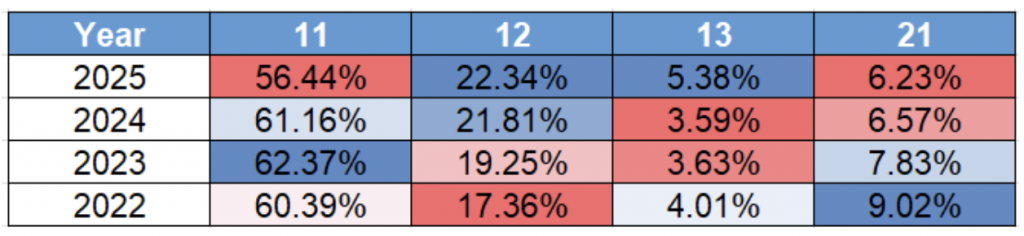
This is reinforced by NFL teams’ transition to increased 12 and 13 personnel rates to counter the new defensive meta. Team WR2s and WR3s are losing playing time, as we see via the personnel usage below.
This is creating a dynamic where team WR2/3s are playing and scoring less than before, potentially reigniting the relative advantage of the Tier 1 WRs. However, even Tier 1 WR scoring was at its lowest since 2017, which probably is capping the market’s interest in early receiver picks.
Tight End
Conversely to receivers, tight ends are playing more, increasing the depth of the position.
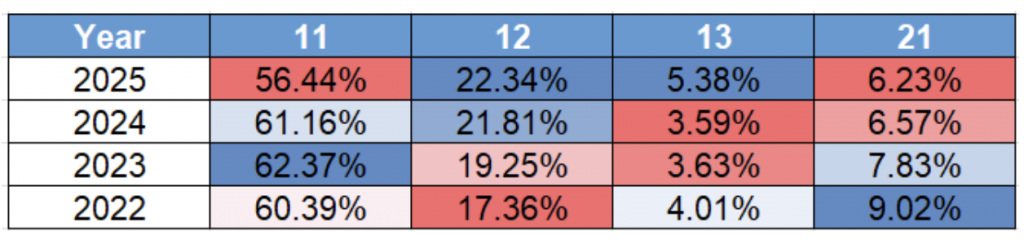
Multi-tight end sets are up from an average of 23% from 2022-24 to 28% in 2025, as teams reduced both their 11 personnel and 21 personnel usage in this time frame.
Additionally, tight ends are probably cheaper than in past seasons, specifically in Rounds 5-11, because of the consistent failure of the tight ends in these rounds, going back over a decade. The best ball community has been wise to this trend for the last two or three seasons, with most folks opting for an elite-or-wait strategy.
However, the use of multi-tight end sets is a complicating factor for strategy at the position. When a slot receiver comes off the field for a secondary tight end, the most talented receiving tight ends probably benefit from the reduced target competition, as we’ve seen with the YPRR personnel splits for WRs. This probably increases the relative value of both the elite tight ends by ADP (Brock Bowers, Trey McBride, and Colston Loveland) and the mid-tier tight ends who are good receivers but less capable blockers (Tyler Warren, Harold Fannin Jr., etc). If the multi-tight end trend holds (and the NFL Draft suggests that it will for at least 2026), figuring out how to play the mid-tier tight ends will likely be a key to the 2026 best ball season.
Running Back
Given that all three of the other positions are falling in top-100 ADP, that leaves the running backs left to benefit. However, I’ll stress this rise is probably as much about the negatives for the other positions as it is about the positives for the running backs. Despite the fall in passing volume and efficiency, rushing efficiency is only slightly up, and running backs aren’t scoring much more than they did in the late 2010s.
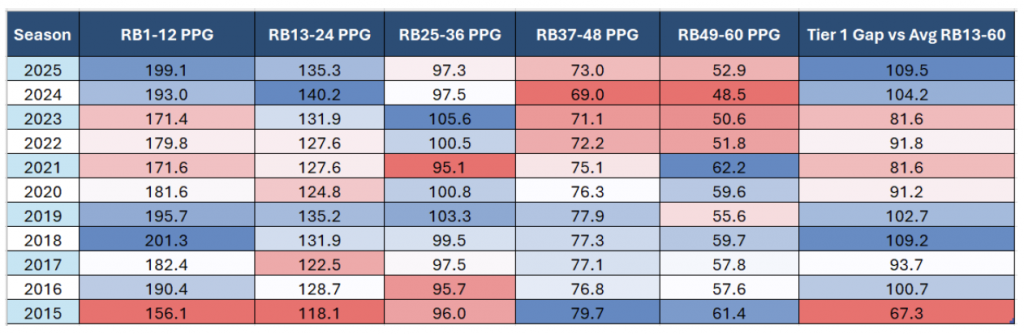
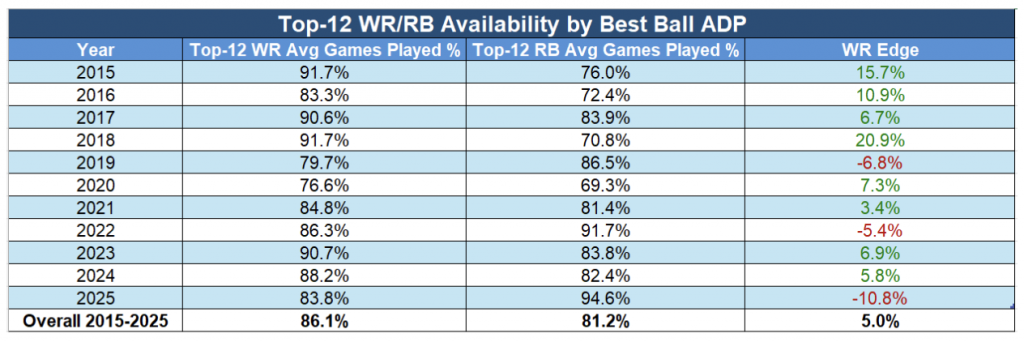
Still, with WRs and QBs scoring less, and mid-round TEs underperforming, that is increasing the relative advantage of running backs. Top-12 RBs have also stayed healthier over the last few seasons, which is probably amplifying the market’s perception of running back value relative to receivers.
How I’m playing the new market in May and June
We've launched a new NFL Best Ball product
Best Ball is a draft-only format. No trades, no waivers, and no setting lineups. Our Best Ball team includes a mix of the most successful players and highly-regarded fantasy analysts: Adam Levitan, Justin Herzig, Evan Silva, Mike Leone, and more.
This product is designed to go well beyond our industry-leading rankings, including ADP, Late-Round Targets, Players to Scroll for, Projected Ownership, Market Movement Reports and more.
Click below to learn more about what’s inside our NFL Premium Best Ball subscription.
Best Ball Product Details » Already a subscriber? Log In